
When I first started reading birth charts, I kept wondering why two people with the same planet in the same sign had completely different lives. The answer was Digbala — the directional strength I had been ignoring. A planet can sit in its own sign and still feel weak if it lacks direction. Once I began checking the Digbala of planets before making any prediction, my readings became sharper and far more honest. This one factor quietly decides whether a planet delivers results or just struggles in the background. In this guide I will keep things simple, walk you through the meaning, the houses, the directions, and the Digbala of planets so you can read a horoscope with more clarity.
What is Digbala? (Meaning & Definition)
Digbala is made of two words — Dig meaning direction and Bala meaning strength or point. So in plain terms, Digbala is the directional strength a planet gains because of where it is placed in the birth chart.
It is one of the 6 types of strength inside the Shadbala system, sitting beside Sthana Bala, Kala Bala, Cheshta Bala, Drik Bala, and Naisargika Bala. While Sthana Bala looks at sign placement, Digbala only cares about house placement. A planet that attains full Digbala scores 60 Virupa (also counted as 60 Shashtiamsa), and a planet at its weakest position drops to 0.
Here is the simple idea I always tell my students: a planet with strong Digbala behaves like a person working in the right environment — it feels favorable, powerful, and auspicious. A planet with zero Digbala feels out of place, no matter how good its dignity looks elsewhere.
Houses & Directions in Digbala
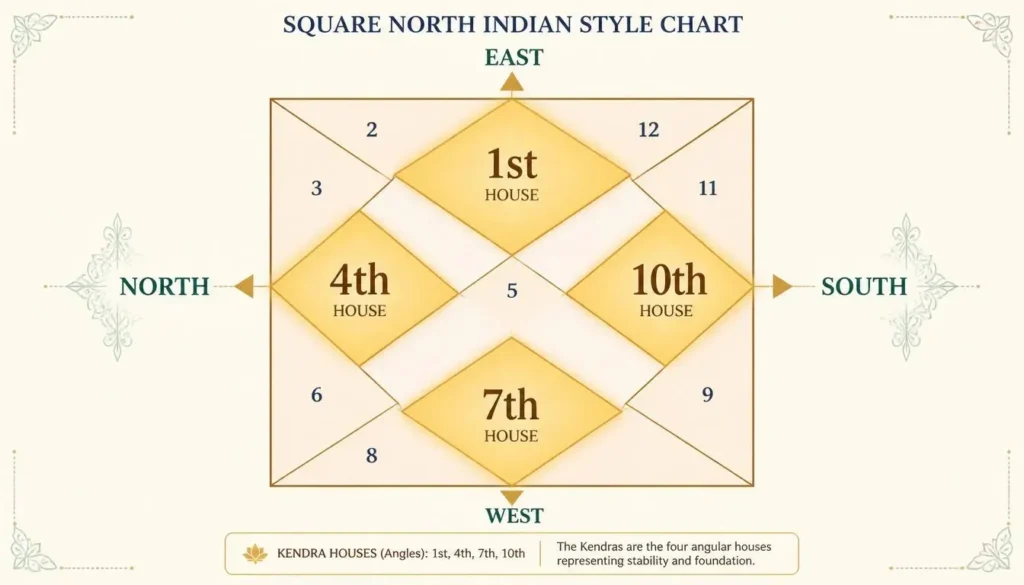
The whole concept rests on the Kendra houses, because each angle of the horoscope points to a cardinal direction. This is something I double-check on every chart before I say a planet is truly strong.
| House | Direction | Meaning in life |
|---|---|---|
| 1st house (Lagna) | East | Self, intelligence, identity |
| 4th house | North | Home, comfort, emotions |
| 7th house | West | Partnership, society, marriage |
| 10th house | South | Career, authority, public reputation |
When a planet occupies the right angle, it gains its full directional strength. When it sits in the opposite house, it slips to zero Digbala.
There is also a deeper layer here — the Dikpalas, also called Lokapalas. These are the divine guardians of the directions, the Devata behind each angle. Indra rules the East, Yama the South, Varuna the West, and Kubera the North, while Agni, Isana, Nirriti, and Vayu guard the inter-cardinal directions. Classical texts like BPHS and Hora Ratnam tie a planet in Digbala to the blessing of its ruling Devata. These principles trace back to classical texts like the Brihat Parashara Hora Shastra. I find this idea beautiful — a strong planet is not just a number, it manifests like a guardian standing in your favour.
Digbala of Planets: Directional Strength of Each Planet
Before going planet by planet, here is the quick reference table I keep beside me — the strongest position and the weakest position for every planet.
| Planet | Full Digbala (60) | Zero Digbala (0) |
|---|---|---|
| Sun | 10th house (South) | 4th house |
| Moon | 4th house (North) | 10th house |
| Mars | 10th house (South) | 4th house |
| Mercury | 1st house (East) | 7th house |
| Jupiter | 1st house (East) | 7th house |
| Venus | 4th house (North) | 10th house |
| Saturn | 7th house (West) | 1st house |
Digbala of Sun
The Sun derives strength in the 10th house, the South direction guarded by Yama. When the Sun gains Digbala, it bestows fame, authority, leadership, and steady public reputation. I have repeatedly seen politicians and senior officials carry a strong Sun here. A Sun at zero Digbala in the 4th house often struggles with confidence and visibility.
Digbala of Moon
The Moon attains Digbala in the 4th house, the North direction. This placement enhances emotional stability, mental strength, and family harmony. A weak Moon in the 10th house can leave a person restless and emotionally scattered, something I always handle gently in a reading.
Digbala of Mars
Mars gains full directional strength in the 10th house, South. A strong Mars here is favorable for the army, surgery, sports, and any work needing courage. When Mars falls to zero Digbala in the 4th house, it can disturb home peace, since this malefic is rarely welcome there.
Digbala of Mercury
Mercury derives strength in the 1st house, the East, guarded by Kubera. A planet like Mercury in Digbala bestows intelligence, sharp speech, logic, and skill in calculation. People with this often feel curious, witty, and favorable in communication-based professions.
Digbala of Jupiter
Jupiter also attains Digbala in the 1st house, East. This is one of the most auspicious placements in a horoscope — it bestows wisdom, morality, and good education. I have seen Jupiter in Lagna quietly balance many afflictions in an otherwise difficult chart.
Digbala of Venus
Venus gains directional strength in the 4th house, the North. A strong Venus here blesses a person with luxury, vehicles, a good spouse, and artistic fame. A Venus with zero Digbala in the 10th house often struggles to bring comfort and relationships into balance.
Digbala of Saturn
Saturn derives strength in the 7th house, the West, the direction of Varuna. A Saturn with Digbala delivers discipline, endurance, and surprisingly stable partnerships and marriage. A weak Saturn in the 1st house at zero Digbala can make life feel heavy and slow.
Digbala of Rahu & Ketu
Most writers skip the shadow planets, but they matter. Rahu behaves like Saturn, so it is considered stronger in the 7th house, the West, linked with Nirriti. Ketu behaves like Mars, gaining strength in the 10th house, South, connected with Anantha. In my own practice, a well-placed Rahu in the 7th quietly supports foreign connections, while a directional Ketu in the 10th manifests as deep, focused, almost spiritual work.
Want to check the strength of planets in your own chart? Don’t just read about Digbala — see it live in your horoscope. Use these free tools to explore your placements:
❤️ Free Love Calculator — get a quick reading on your love and partnership potential
🔭 Free Birth Chart Calculator — generate your full kundali and check every planet’s house placement
💞 Free Synastry Chart Calculator — compare two charts and study relationship compatibility

How to Calculate Digbala — Formula & Example
When I first tried to calculate Digbala by hand, I thought it would be hard maths. It is not. Once you understand the strongest position and the weakest position, the rest is simple subtraction.
The Digbala Formula
The idea is straightforward. A planet gains 60 Shashtiamsa at its strongest position and 0 at its weakest position, which is exactly the opposite house. The simple formula is:
Digbala = (distance of the planet from its weakest point ÷ 180) × 60
If the distance crosses 180 degrees, you subtract it from 360 so the score never goes above 60. That single rule keeps the whole calculation clean.
Step-by-Step Example Calculation
Let me measure it the way I do in a real horoscope.
Suppose the Moon is at 3 degrees Taurus and its weakest point (the meridian) falls at 17 degrees Cancer.
- Distance between the two points = 64 degrees
- Apply the formula: (64 ÷ 180) × 60
- Result = roughly 21 Virupa
So this Moon has about 21 points of Digbala — not strong, not dead, just intermediate. A quick way to assess it without numbers: if a planet sits exactly halfway between its strongest and weakest house, it carries 30 Shashtiamsa, or half Digbala.
Full Digbala vs Zero Digbala Points
Here is the easy summary I keep in mind while reading any chart:
| Position of Planet | Digbala Score | Meaning |
|---|---|---|
| At strongest house | 60 | Full directional strength |
| Halfway point | 30 | Intermediate strength |
| At weakest house (opposite house) | 0 | Zero Digbala |
A planet near 60 feels favorable and powerful. A planet near 0 struggles, even if its sign dignity looks good. This is why I never judge a planet by exaltation alone.
Effects of Strong vs Weak Digbala
The score is only useful when you know what it actually does in a person’s life. Over years of readings, the difference between a strong and a weak planet has been one of the most reliable patterns I have seen.
Results of a Planet with Strong Digbala
A planet with strong Digbala delivers results smoothly in the areas it rules. It manifests like a guardian Devata standing in your favour. In practice, a planet like a directional Sun bestows authority and public reputation; a strong Jupiter enhances wisdom and finances; a well-placed Venus blesses relationships and luxury. The work it governs feels auspicious, timely, and favorable.
Results of a Planet with Weak / Zero Digbala
A planet with weak or zero Digbala does not turn malefic — it simply struggles to express itself. The person feels the planet’s promise but cannot reach it easily. Classical texts like Hora Ratnam describe such natives as restless, drawn to distant lands out of distress, and unstable in that area of life. I usually tell clients this honestly: the talent is there, the direction is missing.
Uses of Digbala in Chart Analysis
This is where Digbala stops being theory and becomes a real tool. I use it in almost every chart analysis to confirm whether a planet can truly deliver.
Career & Profession Predictions
A strong Sun or Mars in the 10th house, South, points to leadership, authority, and a visible career. A directional Mercury in Lagna bestows skill in trade, writing, and communication-based professions. The 10th house Digbala is the first thing I check before guiding anyone on work.
Marriage & Relationships
The 7th house holds the answers here. A strong Saturn with Digbala in the West quietly supports endurance and a stable partnership. A well-placed Venus enhances love and family harmony, while a Venus at zero Digbala often hints at delays or friction in marriage.
Finance & Business
A directional Jupiter in the East bestows ethics, wisdom, and steady financial growth, making it favorable for business. A weak Jupiter in the 7th house can bring repeated challenges in partnership-based ventures — a pattern I have seen more than once.
Digbala During Dasha & Transit Periods
This is the part many people miss. A planet with strong Digbala gives excellent results during its dasha and antardasha period. The same planet with weak Digbala tends to give mixed or delayed outcomes, even in a good transit. I always cross-check Digbala before predicting any dasha result.
How to Strengthen a Weak Digbala Planet
A weak planet is not a dead end. Both astrology and remedies offer ways to support it.
Astrological Rules (Conjunction, Aspect, Nakshatra)
From experience, a planet with low Digbala can borrow strength in three quiet ways:
- Conjunction — when it joins the lord of the house where it gains full Digbala.
- Aspect — when that same lord casts an aspect on it.
- Nakshatra — when the planet sits in the nakshatra of that lord.
A well-placed dispositor can also soften a weak directional score. This is why I never declare a planet finished after just one look.
Remedies for Weak Digbala Planets
Simple, traditional remedies help strengthen the planet so it can manifest better:
- Sun weak — Surya mantra and respect for authority.
- Moon weak — Chandra mantra and donating white items on Mondays.
- Venus weak — charity and fasting on Fridays.
- Saturn weak — service, discipline, and offering oil on Saturdays.
The goal of every remedy is the same — to propitiate the Devata of that direction and help the planet find its missing path.

Digbala vs Sthana Bala vs Cheshta Bala
Many beginners mix these up, so let me keep it simple. All three belong to the Shadbala system — the six-fold strength of a planet — but each measures something different.
| Strength | What it measures |
|---|---|
| Digbala | Directional strength based on house placement (Lagna, 4th, 7th, 10th) |
| Sthana Bala | Positional strength from sign — exaltation, own sign, mooltrikona |
| Cheshta Bala | Motional strength from a planet’s speed and retrogression |
In short, Sthana Bala checks the sign, Cheshta Bala checks the movement, and Digbala checks the direction. I always read all three together, because a planet can look strong in one and weak in another.
Quick Digbala Reference Table
Here is the summary table I keep beside me for fast chart analysis — strongest position, direction, and ruling Devata for every planet.
| Planet | Full Digbala House | Direction | Zero Digbala House | Dikpala (Devata) |
|---|---|---|---|---|
| Sun | 10th house | South | 4th house | Yama |
| Moon | 4th house | North | 10th house | Vayu |
| Mars | 10th house | South | 4th house | Yama |
| Mercury | 1st house | East | 7th house | Kubera |
| Jupiter | 1st house | East | 7th house | Isana |
| Venus | 4th house | North | 10th house | Agni |
| Saturn | 7th house | West | 1st house | Varuna |
| Rahu | 7th house | West | 1st house | Nirriti |
| Ketu | 10th house | South | 4th house | Anantha |
Remember, full Digbala equals 60 Shashtiamsa and the weakest position equals 0.
Conclusion
After years of reading charts, I have learned that Digbala is one of the quietest yet most honest factors in a horoscope. A planet with strong directional strength delivers results with ease, while a planet at zero Digbala simply struggles to find its path. It is only one part of Shadbala, but checking the direction before any prediction has saved me from many wrong readings. Treat Digbala of planets as a guide — it shows you exactly where life flows smoothly and where a little extra effort or remedy is needed.
Ready to go deeper into your chart? Now that you understand directional strength, take the next step and explore the core of your personality:
🌙 Free Moon Sign Calculator — find your true Moon sign and understand your emotional self
⭐ Free Big Three Calculator — discover your Sun, Moon, and Rising signs in seconds
Frequently Asked Questions (FAQs)
What is Digbala of planets in Vedic astrology?
Digbala is the directional strength a planet gains from its house placement in the birth chart. It is one of the 6 strengths in the Shadbala system, deciding how well a planet delivers results.
Which planet gets Digbala in which house?
Sun and Mars gain Digbala in the 10th house, Moon and Venus in the 4th house, Mercury and Jupiter in the 1st house (Lagna), and Saturn in the 7th house.
How is Digbala calculated?
Digbala is found by measuring the planet’s distance from its weakest point, then applying the formula: distance ÷ 180 × 60. A planet scores 60 at its strongest and 0 at its weakest.
What happens when a planet has zero or weak Digbala?
A planet with zero or weak Digbala does not turn malefic, it simply struggles to express itself. The person feels its promise but faces delays in that area of life.
How can I strengthen a planet with weak Digbala?
You can strengthen it through conjunction or aspect with the relevant house lord, nakshatra support, a well-placed dispositor, or traditional remedies like mantra, charity, and fasting.