The Avastha of planets is one of those quiet little tools in Vedic Astrology that completely changed how I read a birth chart. When I first started, I would only look at which planet sat in which house or sign — and my predictions kept missing the mark. Then I came across the concept of Avastha in the Brihat Parashara Hora Shastra, and things finally clicked. Avastha is a Sanskrit word meaning “state” or “condition.” It tells you whether a planet is strong or weak, active or inactive, happy or distressed. Knowing this single thing improved the accuracy of my predictions more than any other technique I had tried.
What is Avastha of Planets?
In simple words, Avastha is the planetary state — the mood and energy a planet carries inside your horoscope. Maharishi Parashara, in the BPHS, explained that every planet behaves like a living being. It goes through a phase in life, just like we do. The same Sun can deliver results like an energetic youth in one chart and like a tired elder in another. The classical texts — BPHS, Uttara Kalamrita, and Phal Deepika — describe these conditions in detail. The point is this: a planet’s placement alone is not enough. You must assess its Avastha to know how much of its full potential it can actually manifest. This concept comes straight from the classical source — the Brihat Parashara Hora Shastra.
Types of Avasthas of Planets
There is not just one type of Avastha. The classics group them into 5 main categories, and each one looks at the planet from a different angle:
| Avastha Type | What It Shows |
|---|---|
| Baladi Avastha | The planetary age — childhood to old age |
| Jagradadi Avastha | The awakened, dreaming, or sleeping state |
| Lajjitadi Avastha | The psychological and emotional state |
| Deeptadi Avastha | Strength based on dignity — exaltation, debilitation |
| Sayanadi Avastha | The posture or physical condition of the planet |
In my own practice, I lean most on Baladi Avastha and Jagradadi Avastha because they are quick to calculate and give clear answers about planetary strength.
Baladi Avastha — The Five Stages of Planetary Age
Baladi Avastha is the easiest place to start. It treats every planet as if it has an age, based on its degree in a sign. Each zodiac sign of 30° is split into 5 equal parts of 6 degrees each. Wherever your planet falls, that is its phase in life.
Bala Avastha (Childhood)
When a planet sits between 0°-6° (in an odd sign), it is in Bala or childhood. Like a child, it is full of energy but immature and unstable. It carries good intentions but cannot deliver results fully. I often see Bala planets give delayed or scattered outcomes.
Kumara Avastha (Adolescence)
In Kumara Avastha (6°-12°), the planet is a teenager — growing, learning, gaining confidence. It is stronger than Bala but still not at peak. Results are moderate and improve with time.
Yuva Avastha (Youth)
This is the prime age. A planet in Yuva Avastha (12°-18°) is powerful, focused, and able to manifest its full potential. In my readings, Yuva planets are the ones that truly perform — they give 100% results.
Vriddha Avastha (Old Age)
At 18°-24°, the planet enters Vriddha — old age. It behaves like a tired elder: experienced but with declining strength and fading influence. Interestingly, Saturn, being naturally elderly, often handles this stage better than other planets.
Mrita Avastha (Death Stage)
The final stage, Mrita Avastha (24°-30°), is the near-death stage. The planet is weak, inactive, and almost powerless to give good outcomes. A planet here needs support from other strong factors in the chart.
How to Calculate Baladi Avastha
The calculation is simple once you know the trick. You only need the degree of the planet.
- In odd signs (Aries, Gemini, Leo, Libra, Sagittarius, Aquarius — signs 1, 3, 5, 7, 9, 11), the stages run in ascending degree — Bala first, Mrita last.
- In even signs (Taurus, Cancer, Virgo, Scorpio, Capricorn, Pisces — signs 2, 4, 6, 8, 10, 12), the order reverses — it runs in descending degree.
So the Sun at 3° in Aries is a happy child in Bala, but the same Sun at 3° in Cancer falls into Mrita Avastha. The degree is identical — the result is opposite.
Avastha and Planetary Strength
This table is the one I keep handy while reading any horoscope:
| Avastha | Odd Sign | Even Sign | Planetary Strength |
|---|---|---|---|
| Bala | 0°-6° | 30°-24° | 25% |
| Kumara | 6°-12° | 24°-18° | 50% |
| Yuva | 12°-18° | 18°-12° | 100% |
| Vriddha | 18°-24° | 12°-6° | 40-50% |
| Mrita | 24°-30° | 6°-0° | 0% |
One honest word from experience: do not treat these numbers as the final verdict. I have seen charts where almost every planet sat in Bala or Mrita Avastha, yet the person achieved great success. Avastha tells you the energy of a planet — but dignity, house placement, and aspects complete the full picture.
Jagradadi Avastha — Conscious States of Planets
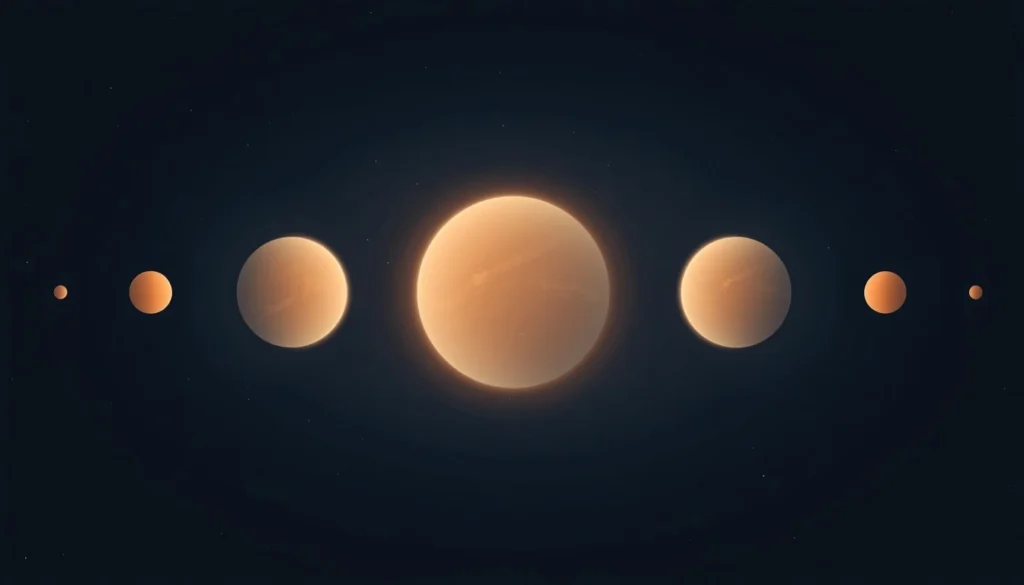
If Baladi Avastha tells you the age of a planet, Jagradadi Avastha tells you whether it is even awake to do its job. This category looks at the planet’s consciousness, and it depends on dignity — which sign the planet sits in. There are 3 states here.
A planet is in Jagrut (the awakened state) when it is in its own sign, exaltation, or Moolatrikona. Such a planet is fully alert and gives 100% results. It is in Swapna (the dreaming state) when placed in a friendly or neutral sign — here it gives partial results, sometimes a little confused or unclear. And it falls into Sushupti (the sleeping state) when placed in an enemy sign or in debilitation — a weak, lazy, ineffective condition. I always pair this with Baladi Avastha. A planet can be in Yuva (prime age) yet also Sushupti (asleep) — and an asleep youth still cannot deliver results properly.
💫 Want to see your planets’ Avastha in action?
Start by knowing your chart inside out:
👉 Free Big Three Calculator
👉 Free Moon Sign Calculator
Lajjitadi Avastha — Psychological & Emotional States
This is my favourite category, because Lajjitadi Avastha reads the emotional state of a planet — its mood, not just its power. A planet has feelings, and these states show whether it is comfortable or troubled inside your chart. There are 6 of them:
| Avastha | Meaning | When It Happens | Effect |
|---|---|---|---|
| Lajjita | Ashamed | With Sun/Saturn/Rahu in an enemy sign | Low confidence, struggles, setbacks |
| Garvita | Proud | In exaltation or Moolatrikona | Powerful, ambitious, full influence |
| Kshudita | Hungry | Combust or with a malefic planet | Frustration, dissatisfaction |
| Trushita | Thirsty | Weak, in a watery sign with malefic aspect | Constant seeking, restless effort |
| Mudita | Happy | With a benefic planet like Jupiter | Joy, success, auspicious results |
| Kshobhita | Disturbed | With Sun plus a malefic aspect | Stress, instability, anxiety |
From experience, a Garvita or Mudita planet behaves like a satisfied person — it shares its gifts freely. A Lajjita or Kshobhita planet is like someone carrying inner stress; even if it is technically strong, it holds back. Planetary moods shape relationships too — explore Lilith Conjunct Venus Synastry.
Deeptadi Avastha — Dignity-Based States
Deeptadi Avastha is purely about dignity — how comfortable a planet is in the sign it occupies. It is close to the idea of exaltation and debilitation, but with more shades. There are 6 levels here too:
- Deepta — the planet is exalted, extremely strong, giving its best results.
- Swastha — the planet is in its own sign, stable and confident.
- Pramudita — placed in a friendly sign, cooperative and beneficial.
- Shanta — in a neutral sign, calm with moderate results.
- Deena — in an enemy sign, weak and struggling.
- Dukhita — fully debilitated, suffering and unable to function well.
I think of Deeptadi Avastha as the “home environment” of a planet. A Deepta planet is living in a palace; a Dukhita planet is stuck somewhere uncomfortable. The BPHS and Uttara Kalamrita both stress that a planet in Deepta brings fame and good karma, while a Dukhita planet often creates obstacles.

How to Interpret Avastha in Your Birth Chart
Here is where most beginners get stuck — they calculate the Avastha but cannot interpret it. The trick is to never read one Avastha alone. I always combine three things: the planet’s natural karaka role, its current Avastha, and its house placement.
A quick practical example: Venus is the karaka of relationships. If Venus sits in the 7th house in Yuva Avastha and is also Jagrut, the person seeks a serious, mature partnership. The same Venus in Bala Avastha points to casual or immature bonds. Another one — Mars in the 6th house in Yuva fights smartly, but Mars in Bala reacts recklessly like a child.
Now the honest part — theory versus practical. The textbooks say a planet at the lowest degree has only 25% strength. But real charts will humble you. I have read horoscopes of very successful people whose key planets sat in Bala or Mrita Avastha. So Avastha is not a final scorecard. Treat it as the mood and energy of a planet — then weigh it with dignity, aspects, Shadbala, and the person’s own effort. That balanced approach is what makes Avastha a powerful predictive tool instead of a rigid formula.
Avastha as a Predictive Tool
Once you are comfortable reading Avastha, it becomes one of the sharpest predictive tools in Vedic Astrology. The method I follow is a simple three-step formula — almost like a chemical equation. First, take the planet’s natural karaka role. Second, check its current Avastha. Third, see its house placement. When you blend these three, the prediction becomes specific instead of vague.
For example, Mercury is the karaka of communication. Mercury in the 3rd house in Yuva Avastha and Jagrut gives a sharp, confident speaker. The same Mercury in Mrita Avastha points to hesitation or delayed results in studies. The Avastha does not change what a planet signifies — it changes how strongly and in what mood the planet will deliver results. This is exactly why two people with the same planet in the same house live very different lives. Mars behaves very differently under tough aspects — see how in Mars Pluto Opposition.
Remedies for Planets in Weak Avastha
A planet in Bala, Mrita, Sushupti, or Dukhita Avastha is not a curse — it simply needs support. Over the years, these are the remedies I have found genuinely helpful for a weak planet:
- Strengthen the karaka — worship or honour the deity linked to that planet, since a sleeping planet responds to focused attention.
- Mantra chanting — regular recitation of the planet’s mantra slowly activates its energy.
- Charity (daan) — donating items ruled by the weak planet on its weekday balances its influence.
- Gemstones — only after proper consultation, a gemstone can lift a planet that is weak but not badly afflicted.
- Conscious effort — the strongest remedy. A planet in Mrita Avastha improves a lot when you consciously work on that area of life.
The honest truth from practice: remedies do not magically turn a Bala planet into a Yuva one. They reduce friction and help the planet give whatever it can, more smoothly.
Conclusion
The Avastha of planets is the difference between reading a birth chart like a flat map and reading it like a living story. A planet is not just placed somewhere — it has an age, a mood, a level of consciousness, and a comfort zone. Baladi, Jagradadi, Lajjitadi, and Deeptadi Avastha each give you one more layer of truth. Learn to calculate them, then interpret them together with dignity, house placement, and karaka. Do that, and your predictions in Vedic Astrology will become far more accurate, human, and real.
💫 Ready to go deeper into your chart?
Explore your placements and connections with these free tools:
👉 Free Synastry Chart Calculator
👉 Free Birth Chart Calculator
👉 Free Love Calculator
Frequently Asked Questions (FAQ)
What is Avastha of planets in Vedic astrology?
Avastha is the state or condition of a planet in a birth chart. Described in the BPHS, it shows whether a planet is strong, weak, awake, or distressed, and how well it can deliver results.
How to calculate the Avastha of a planet in a birth chart?
Use the planet’s degree in its sign. Each 30° sign splits into 5 parts of 6 degrees. In odd signs stages run in ascending degree; in even signs they reverse.
How many types of Avasthas are there for planets?
The classical texts describe 5 main types — Baladi, Jagradadi, Lajjitadi, Deeptadi, and Sayanadi Avastha. Each one assesses the planet from a different angle: age, consciousness, emotion, dignity, and posture.
Which Avastha is the strongest for a planet?
Yuva Avastha (12°-18°) is the strongest in Baladi Avastha, giving 100% results. For dignity, Deepta (exaltation) and for consciousness, Jagrut (the awakened state) make a planet most powerful.
What happens when a planet is in Bala or Mrita Avastha?
A Bala planet acts immature and gives delayed, unstable results. A Mrita Avastha planet is the near-death stage — weak and almost powerless. Both need support from dignity and effort.
How does Avastha affect predictions in a horoscope?
Avastha reveals the mood and inner energy a planet carries. Two charts with the same planet in the same house can still play out differently because their Avasthas differ — and reading this gap is what makes predictions noticeably more reliable.